- PIO
- Safety
- Sciops
- Gemini Home
- Telescopes and Sites
- Instruments
- Observing with Gemini
- Schedules
- Data and Results
- Helpdesk
- Future Instrumentation
- Statistics
- Publications
Change page style:
GMOS
The two Gemini Multi-Object Spectrographs (GMOS), one on each telescope, provide 0.36-1.10 µm long-slit and multi-slit spectroscopy and imaging over a 5.5 arcmin field of view. Each GMOS is also equipped with an Integral Field Unit (IFU) making it possible to obtain spectra of an area of about 35 square arcsec with a sampling of 0.2 arcsec. The Nod-and-Shuffle mode, enabling superior sky subtraction, is available with both GMOSs in most spectroscopic modes.
The GMOSs were built by a collaboration of the Astronomy Technology Centre at the ROE and the University of Durham in the UK and the Herzberg Institute of Astrophysics in Canada. GMOS-N was delivered in July 2001 with GMOS-S following in December 2002.
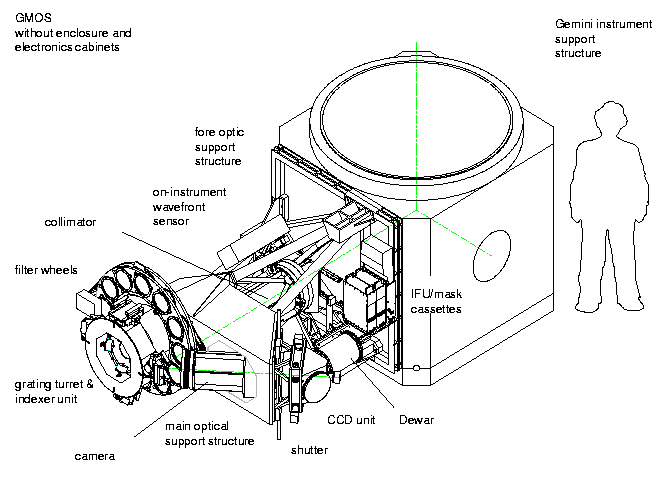
The Instrument Scientists for GMOS are Rodrigo Carrasco (GMOS-S) and Kathy Roth (GMOS-N).
Announcements
No current announcements. See the Status and Availability page for current instrument configurations.
GMOS science highlights
How to use these pages
The GMOS pages are organized as follows.
- Status and Availability: Modes available in the current and upcoming semesters; current grating and slit configurations
- Nod-and-Shuffle: All you ever wanted to know about this remarkable GMOS capability - including when and how to use it
- Imaging: GMOS is not just a MOS, or an S; it is a camera too; info on camera properties, filters and detectors
- Spectroscopy Overview: Introduction and properties of gratings, blocking filters, and detectors
- Long-slit Spectroscopy
- Multi-object Spectroscopy (including mask-making)
- Integral Field Spectroscopy
- Sensitivity and Overheads: Sensitivity tables, integration time calculator, and details of observing overheads
- Guiding Options: The GMOS OIWFS and how to use it; when to use the peripheral wavefront sensors with GMOS
- Calibration: Info on GCAL, flats and arcs, standard stars, and baseline calibrations
- Observation Preparation: How to configure GMOS in the Observing Tool; observing strategies and checklists
- Data Format and Reduction: Examples of GMOS data and links to data reduction resources
- Documents: GMOS optical layout; design documents and references